Twenty years after NASA’s iconic 'Pillars of Creation' image captured
a series of gaseous columns stretching an astonishing five light years
high, the space agency has recaptured the same scene and rendered it in
high-definition.
Originally taken in 1995 by the Hubble Space Telescope, the Pillars of Creation image depicts the massive gas clouds spreading across a small region of the Eagle Nebula, also known as M16, located about 6,500 light years away from Earth. The clouds are impressive on their own, but what makes the image even more unique is that the pillars are bathed in ultraviolet light coming from a cluster of massive stars.
NASA decided to remake the image as part of the 25th anniversary celebration of the Hubble’s launch, which comes around this April.
The agency recaptured the scene in both visible and infrared light, creating an image far more detailed than the previous one. As noted by NASA, new stars can now be seen being born inside the pillars.
Additionally, new details from the image indicate that, in addition to showcasing a region giving birth to new stars, the pillars are also being destroyed by the very star light they are bathed in.
“The ghostly bluish haze around the dense edges of the pillars is material getting heated up and evaporating away into space. We have caught these pillars at a very unique and short-lived moment in their evolution,” said Paul Scowen of Arizona State University in Tempe on NASA’s website.
The top edges of the pillars, particularly the pillar on the left, reveal space matter that is currently being blasted away by radiation from the nearby star cluster.
“These pillars represent a very dynamic, active process,” Scowen added. “The gas is not being passively heated up and gently wafting away into space. The gaseous pillars are actually getting ionized, a process by which electrons are stripped off of atoms, and heated up by radiation from the massive stars. And then they are being eroded by the stars’ strong winds and barrage of charged particles, which are literally sandblasting away the tops of these pillars.”
As amazing as the new image looks, perhaps just as interesting is the fact that what people are looking at now, in high-definition, may not actually exist anymore. According to data from NASA’s Spitzer Space Telescope, the pillars may have actually collapsed some 6,000 years ago after a star exploded. The only reason we are able to see the pillars at all is because of how far away they are from Earth.
“Because light from this region takes 7,000 years to reach Earth, we won't be able to capture photos of the destruction for another 1,000 years or so,” wrote Whitney Clavin of NASA’s Jet Propulsion Laboratory.
Notably, NASA also said that our sun probably formed in a star-forming region very similar to the one captured in the Pillars of Creation image, since it would have needed the kind of strong radiation that blasted the pillars away to be born.
“That’s the only way the nebula from which the sun was born could have been exposed to a supernova that quickly, in the short period of time that represents, because supernovae only come from massive stars, and those stars only live a few tens of millions of years,” said Scowen. “What that means is when you look at the environment of the Eagle Nebula or other star-forming regions, you’re looking at exactly the kind of nascent environment that our sun formed in.”


Originally taken in 1995 by the Hubble Space Telescope, the Pillars of Creation image depicts the massive gas clouds spreading across a small region of the Eagle Nebula, also known as M16, located about 6,500 light years away from Earth. The clouds are impressive on their own, but what makes the image even more unique is that the pillars are bathed in ultraviolet light coming from a cluster of massive stars.
NASA decided to remake the image as part of the 25th anniversary celebration of the Hubble’s launch, which comes around this April.
The agency recaptured the scene in both visible and infrared light, creating an image far more detailed than the previous one. As noted by NASA, new stars can now be seen being born inside the pillars.
Additionally, new details from the image indicate that, in addition to showcasing a region giving birth to new stars, the pillars are also being destroyed by the very star light they are bathed in.
“The ghostly bluish haze around the dense edges of the pillars is material getting heated up and evaporating away into space. We have caught these pillars at a very unique and short-lived moment in their evolution,” said Paul Scowen of Arizona State University in Tempe on NASA’s website.
The top edges of the pillars, particularly the pillar on the left, reveal space matter that is currently being blasted away by radiation from the nearby star cluster.
“These pillars represent a very dynamic, active process,” Scowen added. “The gas is not being passively heated up and gently wafting away into space. The gaseous pillars are actually getting ionized, a process by which electrons are stripped off of atoms, and heated up by radiation from the massive stars. And then they are being eroded by the stars’ strong winds and barrage of charged particles, which are literally sandblasting away the tops of these pillars.”
As amazing as the new image looks, perhaps just as interesting is the fact that what people are looking at now, in high-definition, may not actually exist anymore. According to data from NASA’s Spitzer Space Telescope, the pillars may have actually collapsed some 6,000 years ago after a star exploded. The only reason we are able to see the pillars at all is because of how far away they are from Earth.
“Because light from this region takes 7,000 years to reach Earth, we won't be able to capture photos of the destruction for another 1,000 years or so,” wrote Whitney Clavin of NASA’s Jet Propulsion Laboratory.
Notably, NASA also said that our sun probably formed in a star-forming region very similar to the one captured in the Pillars of Creation image, since it would have needed the kind of strong radiation that blasted the pillars away to be born.
“That’s the only way the nebula from which the sun was born could have been exposed to a supernova that quickly, in the short period of time that represents, because supernovae only come from massive stars, and those stars only live a few tens of millions of years,” said Scowen. “What that means is when you look at the environment of the Eagle Nebula or other star-forming regions, you’re looking at exactly the kind of nascent environment that our sun formed in.”
The three iconic space pillars photographed by NASA's Hubble Space
Telescope in 1995 might have met their demise, according to new evidence
from NASA's Spitzer Space Telescope.
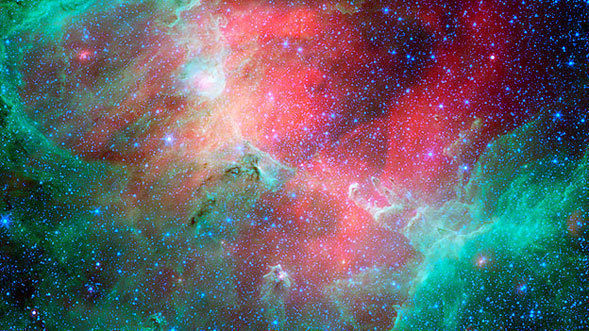
A new, striking image from Spitzer shows the intact dust towers next to a giant cloud of hot dust thought to have been scorched by the blast of a star that exploded, or went supernova. Astronomers speculate that the supernova's shock wave could have already reached the dusty towers, causing them to topple about 6,000 years ago. However, because light from this region takes 7,000 years to reach Earth, we won't be able to capture photos of the destruction for another 1,000 years or so.
Spitzer's view of the region shows the entire Eagle nebula, a vast and stormy community of stars set amid clouds and steep pillars made of gas and dust, including the three well-known "Pillars of Creation."
"I remember seeing a photograph of these pillars more than a decade ago and being inspired to become an astronomer," said Nicolas Flagey of The Institut d'Astrophysique Spatiale in France. "Now, we have discovered something new about this region we thought we understood so well." Flagey, a visiting graduate student at NASA's Spitzer Science Center at the California Institute of Technology in Pasadena, presented the results today at the American Astronomical Society meeting in Seattle.
Astronomers have long predicted that a supernova blast wave would mean the end for the popular pillars. The region is littered with 20 or so stars ripe for exploding, so it was only a matter of time, they reasoned, before one would blow up. The new Spitzer observations suggest one of these stellar time bombs has in fact already detonated, an event humans most likely witnessed 1,000 to 2,000 years ago as an unusually bright star in the sky.
Whenever the mighty pillars do crumble, gas and dust will be blown away, exposing newborn stars that were forming inside. A new generation of stars might also spring up from the dusty wreckage.
Spitzer is a space telescope that detects infrared, longer-wavelength light that our eyes cannot see. This allows the observatory to both see the dust and see through it, depending on which infrared wavelength is being observed. In Spitzer's new look at the Eagle nebula, the three pillars appear small and ghostly transparent. They are colored green in this particular view. In the largest of the three columns, an embedded star is seen forming inside the tip.
Above the pillars is the enormous cloud of hot dust, colored red in the picture, which astronomers think was seared by the blast wave of a supernova explosion. Flagey and his team say evidence for this scenario comes from similarities observed between this hot dust and dust around known supernova remnants. The dust also appears to have a shell-like shape, implying that a supernova blast wave is traveling outward and sculpting it.
The mysterious dust was first revealed in previous images from the European Space Agency's Infrared Space Observatory, but Spitzer's longer-wavelength infrared instrument was able to tentatively match the dust to a supernova event.
"Something else besides starlight is heating this dust," said Dr. Alberto Noriega-Crespo, Flagey's advisor at the Spitzer Science Center. "With Spitzer, we now have the missing long-wavelength infrared data that are giving us an answer."
CREDITS: http://www.spitzer.caltech.edu/news/249-ssc2007-01-Famous-Space-Pillars-Feel-the-Heat-of-Star-s-Explosion
http://rt.com/usa/220387-nasa-pillars-creation-high-def/
A new, striking image from Spitzer shows the intact dust towers next to a giant cloud of hot dust thought to have been scorched by the blast of a star that exploded, or went supernova. Astronomers speculate that the supernova's shock wave could have already reached the dusty towers, causing them to topple about 6,000 years ago. However, because light from this region takes 7,000 years to reach Earth, we won't be able to capture photos of the destruction for another 1,000 years or so.
Spitzer's view of the region shows the entire Eagle nebula, a vast and stormy community of stars set amid clouds and steep pillars made of gas and dust, including the three well-known "Pillars of Creation."
"I remember seeing a photograph of these pillars more than a decade ago and being inspired to become an astronomer," said Nicolas Flagey of The Institut d'Astrophysique Spatiale in France. "Now, we have discovered something new about this region we thought we understood so well." Flagey, a visiting graduate student at NASA's Spitzer Science Center at the California Institute of Technology in Pasadena, presented the results today at the American Astronomical Society meeting in Seattle.
Astronomers have long predicted that a supernova blast wave would mean the end for the popular pillars. The region is littered with 20 or so stars ripe for exploding, so it was only a matter of time, they reasoned, before one would blow up. The new Spitzer observations suggest one of these stellar time bombs has in fact already detonated, an event humans most likely witnessed 1,000 to 2,000 years ago as an unusually bright star in the sky.
Whenever the mighty pillars do crumble, gas and dust will be blown away, exposing newborn stars that were forming inside. A new generation of stars might also spring up from the dusty wreckage.
Spitzer is a space telescope that detects infrared, longer-wavelength light that our eyes cannot see. This allows the observatory to both see the dust and see through it, depending on which infrared wavelength is being observed. In Spitzer's new look at the Eagle nebula, the three pillars appear small and ghostly transparent. They are colored green in this particular view. In the largest of the three columns, an embedded star is seen forming inside the tip.
Above the pillars is the enormous cloud of hot dust, colored red in the picture, which astronomers think was seared by the blast wave of a supernova explosion. Flagey and his team say evidence for this scenario comes from similarities observed between this hot dust and dust around known supernova remnants. The dust also appears to have a shell-like shape, implying that a supernova blast wave is traveling outward and sculpting it.
The mysterious dust was first revealed in previous images from the European Space Agency's Infrared Space Observatory, but Spitzer's longer-wavelength infrared instrument was able to tentatively match the dust to a supernova event.
"Something else besides starlight is heating this dust," said Dr. Alberto Noriega-Crespo, Flagey's advisor at the Spitzer Science Center. "With Spitzer, we now have the missing long-wavelength infrared data that are giving us an answer."
CREDITS: http://www.spitzer.caltech.edu/news/249-ssc2007-01-Famous-Space-Pillars-Feel-the-Heat-of-Star-s-Explosion
http://rt.com/usa/220387-nasa-pillars-creation-high-def/

No comments:
Post a Comment
You can share your feedback with me here!
Thanks!
~ WWS.